


March 19, 2026
What Experienced Buyers Ask Before Buying an Online Business
Learn why predictable recurring revenue wins over higher but inconsistent income — and how to maximize your exit valuation.
When founders prepare to sell a SaaS product, digital business, or subscription-based service, one question keeps coming up:
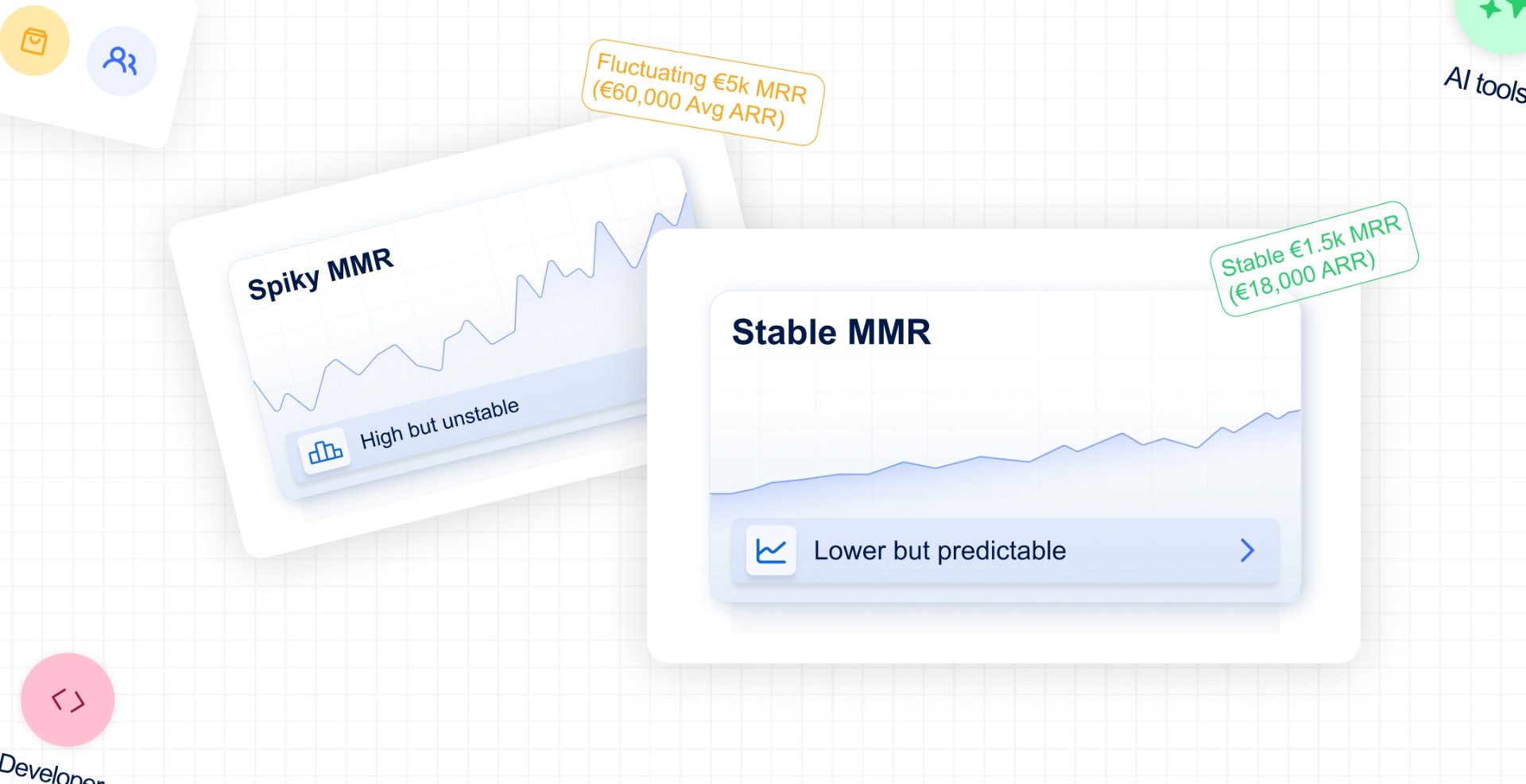
Which is more attractive to buyers — stable €1.5k MRR or fluctuating €5k MRR?
On the surface, the answer looks obvious. €5,000 in monthly recurring revenue dwarfs €1,500. But experienced acquisition buyers rarely make decisions based on peak numbers alone. In practice, revenue predictability often carries more weight than raw revenue size.
A business generating €1,500 consistently every month may be considered more reliable, easier to integrate, and significantly less risky than a business averaging €5,000 with wide monthly swings. Understanding why this happens — and what you can do about it as a founder — can be the difference between a stalled listing and a successful exit. This guide breaks down the stable €1.5k MRR vs fluctuating €5k MRR debate in full: how buyers evaluate recurring income, how stability affects valuation multiples, and what practical steps founders can take to build a more acquirable business.
Unlike one-time sales, recurring revenue creates financial predictability — which is exactly what buyers are paying for when they acquire an online business.
MRR Type:
What It Measures
When these figures remain stable or grow gradually over time, the business becomes significantly easier to evaluate, price, and integrate post-acquisition.
Important distinction: MRR is a useful starting signal, but it is not the same as business valuation. Buyers who understand acquisitions know that the quality of MRR matters as much as the size. Raw MRR numbers can be misleading without context around churn, customer concentration, and revenue consistency.
Let's put two real-world scenarios on the table.
This business generates approximately €1,500 every single month without meaningful deviation.
The income isn't large — but it arrives reliably, month after month.
This business produces significantly more revenue in some months but far less in others.
These are not hypothetical concerns. They are the exact questions buyers ask before making any offer. And when answers are unclear, buyers either walk away or heavily discount their offer.
Acquiring a business is fundamentally a risk assessment exercise. Buyers are not just purchasing today's revenue — they are purchasing confidence in tomorrow's revenue.
When revenue is stable, all of this becomes straightforward. When revenue fluctuates, every projection becomes a guess.
A business with consistent recurring revenue communicates several positive qualities without you having to say a word:
Volatile revenue patterns — even at higher averages — tend to raise red flags:
Key insight for sellers: Buyers don't just fear losing revenue after acquisition. They fear not understanding the revenue well enough to manage it confidently. Unpredictability creates this fear directly.
Related reading: Why Spikes Scare Buyers When Selling an Online Business — a deeper look at why revenue spikes — even impressive ones — create hesitation rather than excitement in experienced acquirers.
Most online businesses are valued using an annual revenue or earnings multiple. The multiple a buyer applies depends heavily on perceived risk — and nothing reduces perceived risk faster than consistent, documented recurring revenue.
Here is how the same raw numbers can produce very different valuations:
The result? A business with stable €1.5k MRR may command a valuation multiple that closes — or even eliminates — the gap with the higher-revenue but volatile competitor. The raw revenue advantage of Business B evaporates when buyers apply a discount for uncertainty.
Related reading: Why MRR Is Not the Same as Real Business Valuation — understand the difference between what your MRR says on paper and what a buyer will actually pay at the negotiation table.
Beyond spreadsheets and multiples, acquisitions run on trust. Buyers need to believe that the numbers they see during due diligence reflect a business that will continue performing after the deal closes. Stable, consistent revenue is one of the clearest trust signals a seller can offer.
Volatile revenue introduces the opposite dynamic. Even honest, well-intentioned sellers can find themselves defending every spike and every dip — which erodes trust even when there's a perfectly reasonable explanation.
Understanding why revenue fluctuates matters both for founders trying to fix it and for buyers trying to assess it.
When customers cancel subscriptions frequently, MRR swings sharply based on when new customers come in to replace them. Low churn is the single most reliable stabilizer of MRR.
Businesses that rely on one acquisition source — a single paid channel, one SEO keyword cluster, one partnership — are extremely vulnerable to disruption. Diversified traffic equals more stable revenue.
A product launch or discount campaign can create impressive revenue spikes that are structurally impossible to repeat. Buyers know this and will probe any month with unusually high numbers.
Some products legitimately experience seasonal demand. This is manageable if clearly documented and consistently patterned — but it must be explained proactively, not discovered by the buyer mid-diligence.
Revenue volatility is not automatically disqualifying. Sophisticated buyers can work with unstable revenue when the context justifies it.
If fluctuations trend upward — even with month-to-month variance — experienced buyers may interpret the pattern as aggressive growth rather than instability. The key is that average monthly revenue must be rising over time.
A product operating in a demonstrably growing market may justify short-term swings. Buyers with long time horizons can tolerate early-stage volatility if the market opportunity is compelling.
If the business has reliable marketing systems — documented funnels, stable CAC, consistent conversion rates — buyers may view revenue fluctuations as manageable rather than structural. In all these cases, the burden is on the seller to provide the documentation that makes the story credible.
Related reading: Pain Points in Risk Assessment: Why Buyers Struggle to Make Confident Decisions — see the full list of factors that create hesitation in buyers, and learn how to proactively address them before you list your business.
If you are planning an exit in the next 12–24 months, the time to improve revenue stability is now — not the week before you list.
Every cancelled subscription is MRR that must be replaced just to stay flat. Invest in customer onboarding, support quality, and product improvements that make cancellation feel like a loss to the customer.
Annual subscriptions lock in revenue for 12 months and smooth out monthly MRR completely. Even a modest conversion rate from monthly to annual plans can dramatically stabilize your revenue chart.
If more than 40–50% of your new customer acquisition comes from a single source, you have a concentration risk. Add organic SEO, email nurture, content, or partnerships alongside any paid channels.
Buyers will ask for churn rate, customer lifetime value, monthly cohort retention, and MRR trend data going back 12–24 months. Having clean, organized records of these metrics dramatically accelerates the acquisition process and builds buyer confidence.
Do buyers always prefer stable revenue over higher fluctuating revenue? In most acquisition scenarios, yes. Predictability reduces risk and makes financial forecasting reliable. Most buyers will apply a discount to uncertain revenue streams regardless of the average size.
Why does MRR matter so much in online business acquisitions? MRR demonstrates ongoing, contracted customer demand. It signals that the business has product-market fit and a reliable income floor — both critical factors in a buyer's risk assessment.
Can a business with fluctuating revenue still sell at a good valuation? Yes, especially if the fluctuations reflect clear growth trends, the seller can explain the root causes, and the business has documented acquisition systems that buyers can trust.
What key metrics do buyers typically examine? Buyers most commonly scrutinize: MRR trend over 12–24 months, monthly churn rate, customer lifetime value, net revenue retention, traffic sources, customer concentration, and founder dependency level.
Is a smaller but stable MRR still attractive to buyers? Absolutely. Stability signals that the business model is proven and the customer base is reliable — both of which give buyers the confidence to acquire and grow the asset.
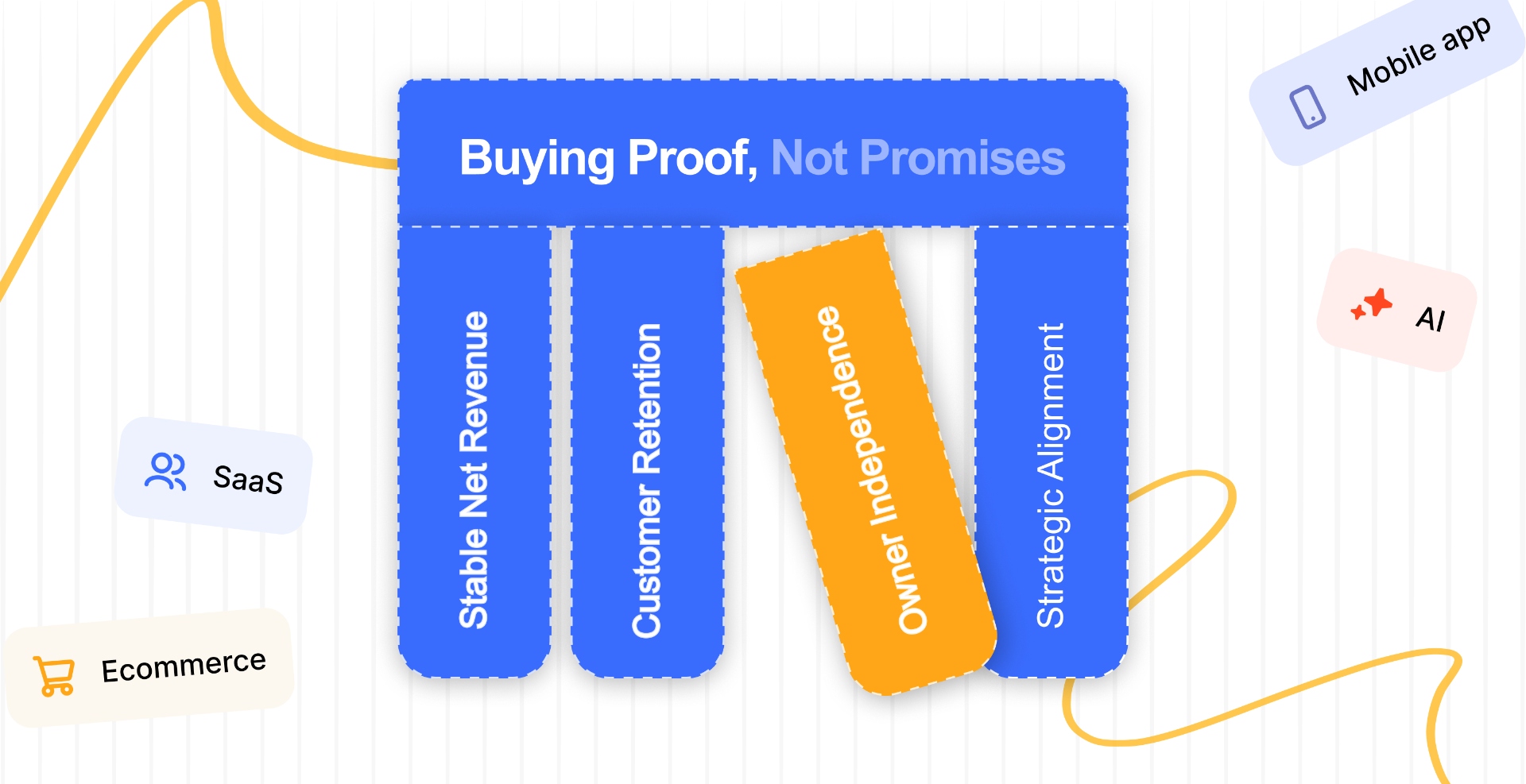
The stable €1.5k MRR vs fluctuating €5k MRR debate reveals a fundamental truth about business acquisitions: buyers are not just purchasing today's revenue — they are purchasing confidence in tomorrow's. Higher average revenue can and does command attention. But when that revenue comes with wide monthly swings and an unclear explanation, experienced buyers pull back. They reduce their offer, extend their due diligence, or walk away entirely.
Stable recurring income — even at a more modest level — signals that the business works reliably, that customers stay, and that the model is ready to scale under new ownership. These qualities reduce risk, build trust, and ultimately drive stronger valuations. For founders who want to build a business worth acquiring, the message is clear: focus on predictable recurring revenue, minimize churn, diversify your acquisition channels, and document everything. These are not just operational improvements — they are the foundations of a successful exit.


.svg)


.svg)
.svg)
.svg)
