


March 19, 2026
What Experienced Buyers Ask Before Buying an Online Business
It can happen during a sale, a leadership transition, a migration to a new platform, or when one team passes responsibility to another. On the surface, a handover may look simple: transfer access, explain a few details, and move on. In reality, a good handover is much more than that.
A poor handover creates confusion, lost knowledge, delayed decisions, broken processes, and sometimes even lost revenue. A strong handover does the opposite. It protects continuity, preserves value, and gives the next person or team the confidence to keep the business moving without disruption. That is why a good handover should never be treated as an afterthought. In online businesses, where operations often depend on digital systems, customer data, traffic channels, and recurring processes, a handover is a critical part of stability.
The foundation of every strong handover is documentation. If key knowledge exists only in one person’s head, the transition is already fragile. The next owner, operator, or team member should not have to guess how the business works or spend weeks reconstructing important details from scattered messages.
In online businesses, this often goes further. Documentation may also need to cover traffic sources, revenue channels, customer support processes, marketing systems, analytics tools, and platform-specific settings.
The goal is simple: the business should remain understandable even after the original operator steps away.
Documentation matters, but communication matters just as much. A handover becomes weak when people assume that others “already know” what is going on. In digital businesses, that assumption can create immediate problems. A missing explanation about a payment workflow, ad account, or supplier process can disrupt operations quickly.
The purpose is not to overwhelm the next person with information. It is to give them enough context to make decisions confidently. Strong communication also reduces one of the biggest handover risks: misunderstanding. When expectations, responsibilities, and priorities are made explicit, the transition becomes much smoother.
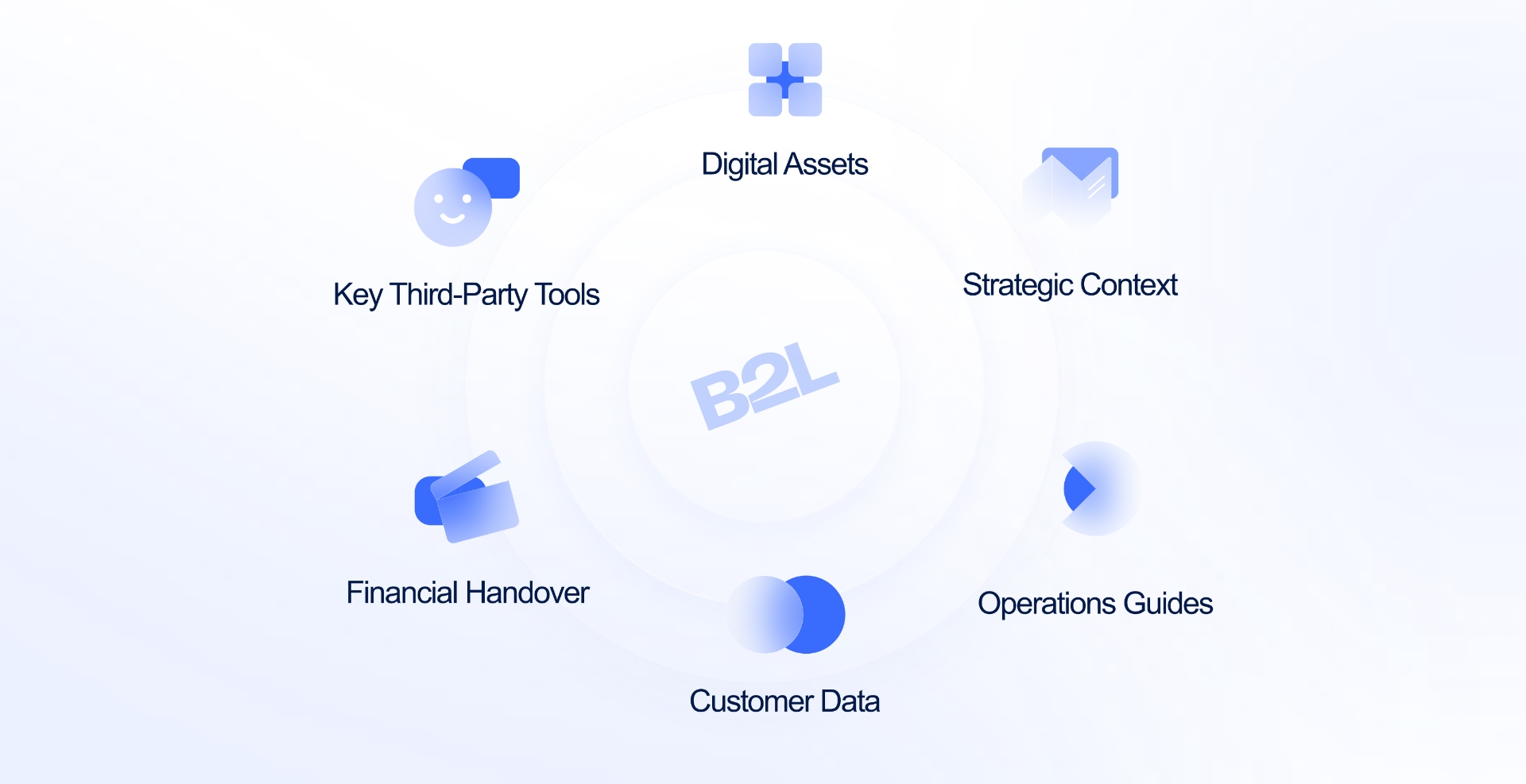
Online businesses depend heavily on digital assets. That is what makes handovers in this space especially sensitive.
If even one of these areas is missed, the buyer or incoming operator may inherit a broken or incomplete business. That is why a proper handover is not just about sharing passwords. It is about making sure the new owner understands what each asset does, how it connects to the rest of the business, and what needs to be maintained after the transition.
The best handovers do not happen randomly. They follow a plan. This usually means the transition is broken into stages, with each stage covering a different responsibility. Instead of trying to transfer everything at once, a good handover moves through a logical structure.
This type of planning is especially important in online businesses because operations often move quickly. Revenue, support, and marketing do not pause just because ownership or responsibility is changing. A good plan keeps the business running while the transfer happens.
One of the most overlooked parts of a handover is context. It is not enough to explain what the next person needs to do. They also need to understand why things are done a certain way, what has already been tried, and where the hidden risks are.
This kind of context saves time and prevents expensive mistakes. It allows the incoming person to build on existing knowledge instead of repeating old problems. In other words, a good handover transfers judgment, not just instructions.
Even with great documentation and planning, some questions only appear after the transition begins. That is why many of the strongest handovers include a support period after the formal transfer. This gives the new owner or operator space to ask follow-up questions, clarify uncertainties, and handle real situations with guidance.
In many cases, this is what turns a technically complete handover into a genuinely successful one. The business does not just change hands. It keeps functioning with confidence.
Understanding what makes a good handover also means understanding what causes bad ones.
In online businesses, these problems can become visible very quickly. Traffic may drop, support may slow down, systems may break, or key knowledge may disappear with the outgoing founder or operator. That is why handovers should be treated as value protection, not administrative cleanup.
A good handover in an online business is not just a transfer of access. It is a transfer of clarity, systems, and confidence. It protects the continuity of the business by making sure the next person understands how things work, what matters most, and how to keep operations moving without unnecessary disruption.
In the end, a handover is successful when the business keeps functioning smoothly after the original person steps away. That is the real sign that the business was built well - and handed over the right way.

.svg)


.svg)
.svg)
.svg)
